
29 Oct 2026
U-87 MG cells
U-87 MG, the human primary glioblastoma cell line, is widely used in biological research. Particularly, these cells are employed in neuroscience and immuno-oncology fields.
1. General characteristics and origin of U-87 MG cell line
This section will go over the origin and general characteristics of the U87 cell line. You will learn What are U-87 MG cells? Where does U87 cell come from? What is the full form of U-87 MG? How big are U87 cells? and What is the morphology of U87 cell line?
- The U87 cell line is a glioblastoma, astrocytoma cell line. It was established in 1966 at Uppsala University. The cells were obtained from a 44-year-old Caucasian male suffering from glioblastoma disease. This cell line is formally called U 87 MG, which stands for Uppsala 87 Malignant Glioma.
- U 87 MG cells represent epithelial cell-like morphology.
- The size of U 87 MG cells ranges between 12 to 14 µm in diameter.
- This human glioblastoma cell line is hypodiploid and possesses a modal chromosome number of 44 in approximately 48% cell population. However, higher ploidies also exist in 5.9% cell population.
Medical 3D animation explaining the genesis of tumours from astrocytes.
2. U-87 MG cells culturing information
Before working with U 87 MG cells, you should learn about the following key points for culturing these glioblastoma cells. Particularly, you should know: What is the population doubling time of U 87 MG cells? What media is used for culturing U87 cells? What is the seeding density of the U 87 MG cell line?
Key Points for Culturing U-87 MG Cells
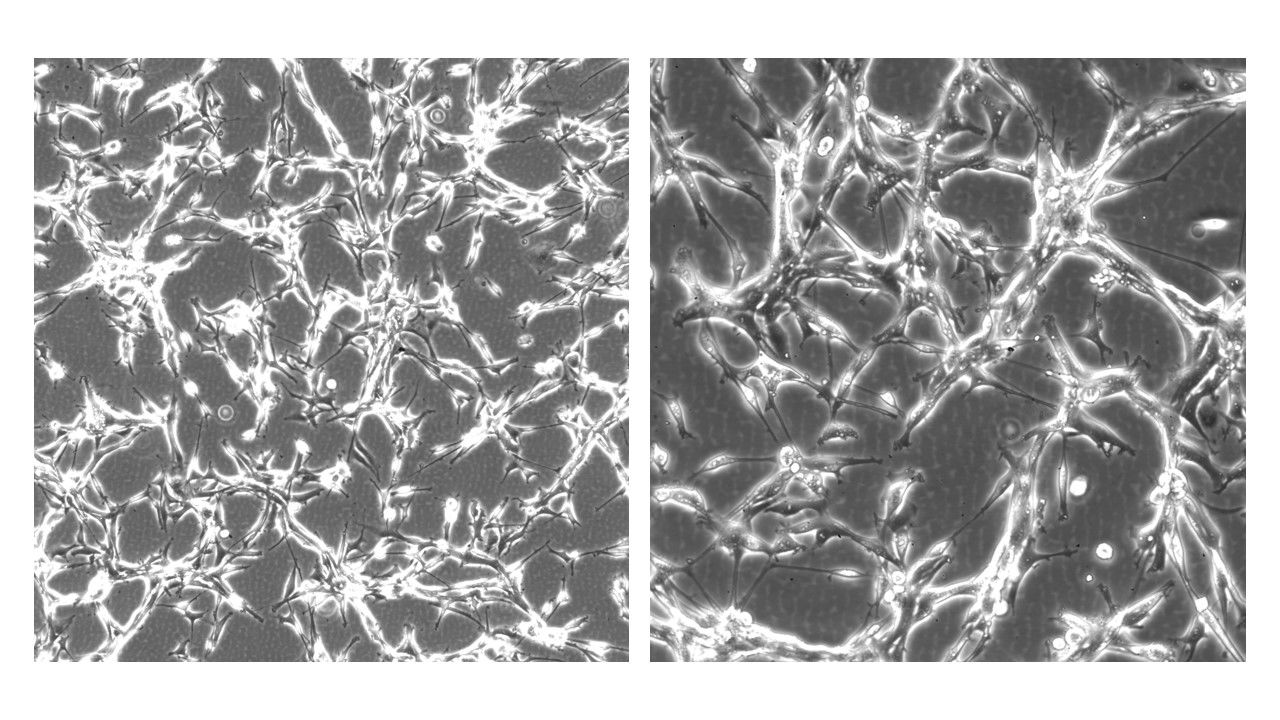
U-87 MG cells under the microscope with 10x and 20x magnification.
3. Advantages & disadvantages of U-87 MG cells
When we think of a cell line, the first thing that strikes our mind is: What are the advantages of using U-87 MG cells? and What are the disadvantages of U87 cells?
Advantages
U 87 MG cell lines are broadly used in research. A few advantages associated with this cell line are:
Disadvantages
The disadvantages of the U 87 MG cell line are:
4. Research applications featuring U-87 MG cells
U87MG glioblastoma cell line is extensively utilized in cancer studies, particularly in glioblastoma research. Some of the research applications of U 87 MG cells are:
Cancer biology research: The U87 cell line is used to study cancer growth and development, underlying molecular mechanisms, signalling pathways, and tumour microenvironment. A study published in 2020 used a glioblastoma in vitro model, U-87 MG cell line, to investigate the BMAL1 (Basic Helix-Loop-Helix ARNT Like 1) gene as a therapeutic target. The findings showed that the BMAL1 gene inhibits glioblastoma cell proliferation, migration, and invasion by suppressing cyclin B1, metalloproteinase-9, and phospho-AKT gene expression [1]. Another research carried out in 2019 utilized the U87cell line and investigated that downregulated Lipopolysaccharide-induced tumour necrosis factor-alpha factor (LITAF) transcription factor expression can enhance the radiosensitivity of glioma cells through FOXO-1 pathway upregulation. LITAF is also known as p53-induced gene 7 (PIG7) [2].
Drug discovery and development: U-87 MG cells can be used for drug screening and testing purposes, allowing researchers to identify new potential anticancer drugs and assess their efficacy and toxicity. As research used U 87 MG glioblastoma cell line to evaluate the anticancer and antioxidant potential of antioxidant and anticancer activities of Inula helenium (L.) extract [3]. Similarly, another publication mentioned using the U87 cell line to test the cytotoxic and apoptotic effect of plant extracts [4]. Furthermore, research published in 2018, studied the cytotoxic effect of sesquiterpene alkaloids extracted from Nuphar plants on sensitive and drug-resistant U 87 MG cell lines [5].
5. U-87 MG cell line: Research Publications
Here are some prominent research publications featuring U 87 MG cell line.
This article published in Neuroreport 2018 proposed that hypoxia could increase human glioblastoma cells migration and invasion by regulating the PI3K/Akt/mTOR/HIF-1α signaling pathway.
This study is published in the Frontiers in Pharmacology in 2020. The research findings state that a flavonoid, Eriodictyol, exerts anticancer effects on the U87 cell line and suppresses cell proliferation and metastasis. The compound mediates its antitumor properties by modulating PI3K/Akt/NF-κB pathway.
This research in Evidence-Based Complementary and Alternative Medicine (2018) suggests that a Chinese herbal formula called Xihuang pill can induce apoptosis in U87 cells by targeting ROS-activated Akt/mTOR/FOXO1 cascade.
LITAF enhances radiosensitivity of human glioma cells via the FoxO1 pathway
This research paper was published in the Cellular and Molecular Neurobiology journal in 2019. The study proposed that a transcription factor, LITAF, downregulates and enhances the radiosensitivity of glioma cells by regulating the FOXO-1 signalling pathway.
This article was published in Biointerface Research in Applied Chemistry (2019). The researchers used U 87 MG cells to investigate the cytotoxic effect of curcumin-loaded PLGA nanoparticles.
6. Resources for U-87 MG cells: Protocols, Videos, and More
U87MG glioblastoma cell line is used in many cancer research laboratories. A few resources featuring this cell line are:
Transfection of U87 cell line: This document will describe to you a transfection protocol for U 87 MG cells.
U 87 MG cell line transfection: This video is a tutorial explaining step by step transfection protocol of U87 cells.
The resource for the cell culture protocol of U87 cells is listed below:
U87 MG cells: This link contains basic information about U 87 MG cell line. It includes brief cell splitting, freezing, and cell thawing protocols.
References
Gwon, D.H., et al., BMAL1 Suppresses Proliferation, Migration, and Invasion of U87MG Cells by Downregulating Cyclin B1, Phospho-AKT, and Metalloproteinase-9. Int J Mol Sci, 2020. 21(7).
Huang, C., et al., LITAF Enhances Radiosensitivity of Human Glioma Cells via the FoxO1 Pathway. Cell Mol Neurobiol, 2019. 39(6): p. 871-882.
Koc, K., et al., antioxidant and anticancer activities of extract of Inula helenium (L.) in human U-87 MG glioblastoma cell line. J Cancer Res Ther, 2018. 14(3): p. 658-661.
Rezadoost, M.H., H.H. Kumleh, and A. Ghasempour, Cytotoxicity and apoptosis induction in breast cancer, skin cancer and glioblastoma cells by plant extracts. Mol Biol Rep, 2019. 46(5): p. 5131-5142.
Fukaya, M., et al., Cytotoxicity of sesquiterpene alkaloids from Nuphar plants toward sensitive and drug-resistant cell lines. Food Funct, 2018. 9(12): p. 6279-6286.