Skip to content

สื่อและสารตั้งต้น

40 products

Insulin, Human recombinant, Solution (5 mg/ml)

Volume: 5 ml Storage: +2°C to +8°C Sterility: Sterile-filtered Insulin Human Recombinant Solution is a chemically defined supplement commonly used for the cultivation of mammalian cell lines, including Chinese Hamster Ovary (CHO) cells. This cell culture–grade solution contains recombinant human insulin expressed in Saccharomyces cerevisiae, ensuring high purity and consistent performance in research applications. Application and Benefits Insulin is routinely added to serum-free and chemically defined media to promote cell growth and productivity. As a key regulatory hormone, insulin supports cellular uptake, utilization, and storage of glucose, amino acids, and fatty acids. It also inhibits the breakdown of glycogen, proteins, and lipids, thereby contributing to improved cell viability and metabolic stability in culture systems. The chemically defined formulation supports reproducibility and minimizes variability in sensitive cell culture workflows. Biological Properties and Usage Insulin is a two-chain polypeptide hormone naturally produced by the β-cells of the pancreatic islets. It has a molecular weight of approximately 5,800 Da. The α- and β-chains are linked by two interchain disulfide bonds, and the α-chain contains one intrachain disulfide bond. For cell culture applications, the solution should be handled under aseptic conditions and stored at +2°C to +8°C to maintain stability and performance. For research use only. Not for use in diagnostic or therapeutic procedures. Not for use in humans or animals.

€109.00

excl. tax and shipping

Insulin-Transferrin-Selenium (ITS), Solution 100x

Volume: 10 ml Storage: +2°C to +8°C Sterility: Sterile-filtered Insulin-Transferrin-Selenium (ITS) Solution (100x) is a chemically defined supplement designed for a wide range of cell culture applications. It is most commonly used as an additive to basal cell culture media to support cell growth under reduced-serum or serum-free conditions. Application and Benefits Our ITS supplement provides essential components required for the optimal performance of serum-free media. By supplementing conventional nutrient media with ITS, the fetal bovine serum (FBS) requirement for the routine maintenance of many cell lines can be significantly reduced. This helps minimize variability associated with serum use while maintaining consistent cell growth and viability. Insulin supports cellular uptake and metabolism of key nutrients, transferrin facilitates iron transport, and selenium contributes to antioxidant defense and enzymatic activity. Together, these components promote balanced cell metabolism and improved reproducibility in defined culture systems. Formulation and Usage Insulin-Transferrin-Selenium (ITS) is supplied as a 100x concentrated solution in Earle's Balanced Salt Solution (EBSS) without phenol red. For standard applications, dilute 1:100 into the appropriate basal medium to achieve the recommended working concentration. Store at +2°C to +8°C and handle under aseptic conditions to maintain product stability and sterility. For research use only. Not for use in diagnostic or therapeutic procedures. Not for use in humans or animals.

€59.00

excl. tax and shipping

McCoys 5A medium (modified), w: 3.0 g/L Glucose, w: stable Glutamine, w: 2.0 mM Sodium pyruvate, w: 2.2 g/L NaHCO3

McCoy's 5A Medium is a highly recommended and specialized medium designed to facilitate the growth and replication of viruses in primary cell cultures. It has gained significant recognition for its exceptional performance in various biological research applications. One prominent application of McCoy's 5A Medium is its utilization in the culturing of human colon carcinoma cell lines. Specifically, it has been employed in the study of the leucine-rich repeat-containing G-protein-coupled receptor (LGR5) and its role in the metastasis of colon cancer. This medium has been effectively employed in the cultivation of several colon carcinoma cell lines, including HCT116, RKO, FET, CBS, HCT116b, and TENN, enabling researchers to delve deeper into the mechanisms underlying colon cancer metastasis. In addition to its application in cancer research, McCoy's 5A Medium has proven to be indispensable in the study of osteoblasts. Researchers investigating the ion reactivity of calcium-deficient hydroxyapatite in standard cell culture media have utilized this medium to culture osteoblasts. This application has facilitated a better understanding of the interactions between osteoblasts and calcium-deficient hydroxyapatite, contributing to advancements in the field of bone research. McCoy's 5A Medium was meticulously formulated by modifying the amino acids found in Basal Medium Eagle to provide optimal support for liver tumor cells. This enriched formulation enables its suitability for a diverse range of established cell lines, as well as primary cells, further enhancing its versatility and applicability in various research settings. McCoy's 5A Medium extends its biochemical and physiological effects beyond liver tumor cells. It has been successfully employed to support growth in primary cultures of bone marrow, skin, gingiva, kidney, omentum, adrenal, lung, spleen, rat embryo, and other cell types. This wide range of applications attests to the broad utility of McCoy's 5A Medium in supporting the growth and maintenance of various cell types for comprehensive biological research. Formulation This McCoy's 5A medium (modified) contains 3.0 g/L of Glucose, stable Glutamine, 2.0 mM of Sodium pyruvate, and 2.2 g/L of NaHCO3. Quality control • pH = 7.2 +/- 0.02 at 20-25°C. • Each lot has been tested for sterility and absence of mycoplasma and bacteria. Maintenance • Keep refrigerated at +2°C to +8°C in the dark. Freezing and warming up to +37°C minimize the quality of the product. • Do not heat the medium to more than 37°C or use uncontrollable sources of heat (e.g., microwave appliances). • If only a part of the medium is to be used, remove this amount from the bottle and warm it up at room temperature. • Shelf life for any medium except for the basic medium is 6 to 8 weeks from the date of opening. Composition Components mg/L Inorganic SaltsCalcium chloride x 2H2O132.00 Magnesium sulfate97.67 Potassium chloride400.00 Sodium chloride6,460.00 Disodium hydrogen phosphate (anhydrous)504.00 Other ComponentsD(+)-Glucose (anhydrous)3,000.00 Glutathione (reduced)0.50 Meat Peptone600.00 Phenol red sodium salt11.00 Amino AcidsL-Alanine13.36 L-Arginine x HCl42.14 L-Asparagine x H2O45.03 L-Aspartic acid19.97 L-Cysteine x HCl x H2O31.75 L-Glutamine (stable)219.15 L-Glutamic acid22.07 Glycine7.51 L-Histidine x HCl x H2O20.96 L-Hydroxyproline19.67 L-Isoleucine39.36 L-Leucine39.36 L-Lysine x HCl36.54 L-Methionine14.92 L-Phenylalanine16.52 L-Proline17.27 L-Serine26.28 L-Threonine17.87 L-Tryptophan3.06 L-Tyrosine disodium salt26.10 L-Valine17.57 Vitaminsp-Aminobenzoic acid1.00 Ascorbic acid0.56 D(+)-Biotin0.20 D-Calcium pantothenate0.20 Choline chloride5.00 Folic acid10.00 myo-Inositol36.00 Nicotinamide0.50 Nicotinic acid0.50 Pyridoxal HCl0.50 Pyridoxine HCl0.50 Riboflavin0.20 Thiamine HCl0.20 Vitamin B122.00

€30.00

excl. tax and shipping

Medium 199, w: 2.7 mM stable Glutamine, w: 2.2 g/L NaHCO3, w: EBSS

Medium 199 is a versatile and widely used cell culture medium specially formulated for the cultivation of primary explants. This comprehensive medium combines essential vitamins, amino acids, and other factors to provide a fully defined nutrient source for a variety of cell types. It is particularly suitable for non-transformed cells, making it an invaluable tool for biological research. Medium 199 offers a range of applications in the field. It can effectively maintain the cumulus-oocyte complex (COC) and support the in vitro maturation of oocytes. Additionally, it is employed in the rinsing of aspiration lines during ovum collection from German Holstein cows. Moreover, Medium 199 serves as an excellent medium for the culture of cardiac endothelial cells derived from rats. These applications demonstrate the versatility and adaptability of Medium 199 to various experimental needs. History The development of Medium 199 in the 1950s marked a significant advancement in tissue culture media. Prior to its introduction, many culture media relied on animal-derived products and tissue extracts. However, Morgan and colleagues revolutionized the field by formulating a completely defined nutritional source for cell cultures. Through their experiments involving different combinations of vitamins, amino acids, and other factors, they discovered the exceptional growth-promoting properties of Medium 199. Quality control • pH = 7.2 +/- 0.02 at 20-25°C. • Each lot has been tested for sterility and absence of mycoplasma and bacteria. Maintenance • Keep refrigerated at +2°C to +8°C in the dark. Freezing and warming up to +37° C minimize the quality of the product. • Do not heat the medium to more than 37° C or use uncontrollable sources of heat (e.g., microwave appliances). • If only a part of the medium is to be used, remove this amount from the bottle and warm it up at room temperature. • Shelf life for any medium except for the basic medium is 8 weeks from the date of manufacture. Composition Components mg/L Inorganic Salts Calcium chloride x 2H2O 264,92 Iron (III) nitrate x 9H2O 0,72 Magnesium sulfate 97,67 Potassium chloride 400,00 Sodium acetat x 3H2O 82,95 Sodium chloride 6,800.00 Sodium dihydrogen phosphate x H2O 140,00 Other Components Adenine sulfate 10,00 AMP 0,20 ATP 1,00 Cholesterol 0,20 2‘-Deoxyribose 0,50 D(+)-Glucose anhydrous 1,000.00 Glutathione (red.) 0,05 Guanine x HCl 0,30 Hypoxanthine 0,30 Phenol red 10,00 D-Ribose 0,50 Thymine 0,30 Tween 80 4,90 Uracil 0,30 Xanthine 0,30 NaHCO3 2,200.00 Amino Acids L-Alanine 25,00 L-Arginine x HCl 70,00 L-Aspartic acid 30,00 L-Cysteine x HCl x H2O 0,10 L-Cystine 20,00 L-Glutamine stable 149,00 L-Glutamic acid 67,00 Glycine 50,00 L-Histidine x HCl x H2O 21,88 L-Hydroxyproline 10,00 L-Isoleucine 20,00 L-Leucine 60,00 L-Lysine x HCl 70,00 L-Methionine 15,00 L-Phenylalanine 25,00 L-Proline 40,00 L-Serine 25,00 L-Threonine 30,00 L-Tryptophan 10,00 L-Tyrosine 40,00 L-Valine 25,00 Vitamins 4-Amino benzoic acid 0,05 Ascorbic acid 0,05 D(+)-Biotin 0,01 Calciferol 0,10 D-Calcium pantothenate 0,01 Choline chloride 0,50 Folic acid 0,01 myo-Inositol 0,05 Menadione 0,01 Nicotinic acid 0.025 Nicotinamide 0.025 Pyridoxal x HCl 0.025 Pyridoxol x HCl 0.025 Riboflavin 0,01 DL-α-Tocopherol phosphate disodium salt 0,01 Thiamine x HCl 0,01 Vitamine A acetate 0,14

€40.00

excl. tax and shipping

NCI-H295R Cell Growth Medium

Discover the advanced NCI-H295R Cell Growth Medium, an expertly crafted nutrient solution specifically designed to foster the growth and maintenance of mammalian cell lines, including the specialized NCI-H295R cells. This medium stands out with its unique blend of Dulbecco's Modified Eagle Medium (DMEM) and Ham's F-12 (Nutrient Mixture F-12) in a precise 1:1 ratio, enriched with essential supplements to meet the intricate needs of cell culture. Enhanced Formulation for Superior Cell Culture Performance • Supplemented Baseline: The basic medium is already rich, combining DMEM's high amino acid and vitamin concentrations with the diverse nutrients of Ham's F-12. To this potent mix, we've added 5% Fetal Bovine Serum (FBS), providing crucial growth factors, hormones, and proteins. • Tailored Additives: Beyond FBS, this medium is fortified with critical supplements including Insulin, Transferrin, Bovine Serum Albumin, Selenious Acid, and Lineloic Acid. These additions cater to specific cellular requirements, promoting enhanced cell growth, metabolic function, and overall health. • L-Glutamine Boost: The presence of L-glutamine further amplifies the medium's efficacy, supporting essential metabolic processes and encouraging robust cell proliferation. Optimized for Cell Culture • pH Controlled Environment: Incorporating a bicarbonate buffer system and phenol red indicator, the medium ensures a stable pH environment. It is optimized for a 5% CO2 atmosphere, allowing for precise pH monitoring and adjustment. • Quality and Purity: Each lot of basic medium undergoes rigorous testing for sterility, mycoplasma, and bacteria, ensuring the medium's integrity. With a pH maintained medium, you can trust in the consistent quality and performance of this medium. Handling and Storage Maintain the medium's quality by storing it refrigerated at +2°C to +8°C, away from light. Avoid extremes, such as freezing or overheating, to preserve its efficacy. For partial use, gently warm the needed quantity at room temperature, ensuring the medium is brought to the appropriate condition without compromising its components. Shelf life With an 8-week shelf life from the manufacturing date, the NCI-H295R Cell Growth Medium is a reliable choice for your cell culture needs, ensuring the vitality and productivity of your research.

€150.00

excl. tax and shipping

PBS

Phosphate-buffered saline (PBS) is a widely used buffer solution in biological and chemical research. It plays a crucial role in maintaining the pH balance and osmolarity during various experimental procedures, including tissue processing and cell culture. Our PBS solution is meticulously formulated with high-purity ingredients to ensure stability and reliability in every experiment. The osmolarity and ion concentrations of our PBS closely mimic those of the human body, making it isotonic and non-toxic to most cells. Composition of Our PBS Solution Our PBS solution is a pH-adjusted blend of ultrapure-grade phosphate buffers and saline solutions. At a 1X working concentration, it contains: • 8000 mg/L Sodium chloride (NaCl) • 200 mg/L Potassium chloride (KCl) • 1150 mg/L Sodium phosphate dibasic anhydrous (Na2HPO4) • 200 mg/L Potassium phosphate monobasic anhydrous (KH2PO4) This composition ensures an optimal pH and ionic balance, suitable for a wide range of biological applications. Applications of Our PBS Solution Our PBS solution is ideal for various applications in biological research. Its isotonic and non-toxic properties make it suitable for substance dilution and cell container rinsing. PBS solutions containing EDTA are effective for disengaging attached and clumped cells. However, divalent metals such as zinc should not be added to PBS, as this can cause precipitation. In such cases, Good's buffers are recommended. Additionally, our PBS solution is an acceptable alternative to viral transport medium for the transport and storage of RNA viruses, including SARS-CoV-2. Quality Control • Sterile-filtered Storage and Shelf Life • Store at +2°C to +25°C, protected from light. • Once opened, store at 2°C to 25°C and use within 24 months. Shipping Conditions • Ambient temperature Maintenance • Keep refrigerated at +2°C to +8°C in the dark. Avoid freezing and frequent warming to +37°C, as it reduces product quality. • Do not heat the medium beyond 37°C or use uncontrolled heat sources such as microwave appliances. • If only part of the medium is to be used, remove the required amount and warm it to room temperature before use. Composition Category Components Concentration (mg/L) Salts Potassium chloride 200 Potassium phosphate monobasic anhydrous 200 Sodium chloride 8000 Sodium phosphate dibasic anhydrous 1150

€20.00

excl. tax and shipping

RPMI 1640, w: 2.0 mM stable Glutamine, w: 2.0 g/L NaHCO3

RPMI 1640 Medium, also known as RPMI medium, is a highly versatile cell culture medium widely utilized in biological research to cultivate various mammalian cells. Developed by George E. Moore, Robert E. Gerner, and H. Addison Franklin in 1966 at the renowned Roswell Park Comprehensive Cancer Center, this medium derived its name from its origin at the Roswell Park Memorial Institute (RPMI). Initially designed to support the growth of human leukemic cells in both suspension and monolayer cultures, RPMI 1640 Medium has evolved through modifications by researchers and commercial suppliers to become suitable for a diverse range of mammalian cells. It is exceptionally compatible with cell lines such as HeLa, Jurkat, MCF-7, PC12, PBMC, astrocytes, and carcinomas. RPMI 1640 Medium stands apart from other cell culture media due to its unique composition. It contains a substantial amount of phosphate, amino acids, and vitamins. Notably, it encompasses biotin, vitamin B12, and PABA, absent in Eagle's Minimal Essential Medium or Dulbecco's Modified Eagle Medium. Moreover, RPMI 1640 Medium exhibits significantly elevated concentrations of vitamins inositol and choline. However, it does not contain proteins, lipids, or growth factors. Consequently, supplementation with 10% Fetal Bovine Serum (FBS) is commonly required to provide optimal conditions for cell growth. The buffering system of RPMI 1640 Medium relies on sodium bicarbonate and necessitates a 5-10% CO2 environment to maintain a physiologically appropriate pH. The inclusion of the reducing agent glutathione further distinguishes this medium from others. Quality Control • Sterile-filtered Storage and Shelf Life • Store at +2°C to +8°C, protected from light. • Once opened, store at 4°C and use within 6–8 weeks. Shipping Conditions • Ambient temperature Maintenance • Keep refrigerated at +2°C to +8°C in the dark. Avoid freezing and frequent warming to +37°C, as it reduces product quality. • Do not heat the medium beyond 37°C or use uncontrolled heat sources such as microwave appliances. • If only part of the medium is to be used, remove the required amount and warm it to room temperature before use. Composition Category Components Concentration (mg/L) Amino Acids Glycine 10.00 L-Alanyl-L-Glutamine 434.40 L-Arginine 200.00 L-Asparagine H2O 56.82 L-Aspartic Acid 20.00 L-Cystine 2HCl 65.20 L-Glutamic Acid 20.00 L-Histidine HCl H2O 20.27 L-Hydroxy-L-Proline 20.00 L-Isoleucine 50.00 L-Leucine 50.00 L-Lysine HCl 40.00 L-Methionine 15.00 L-Phenylalanine 15.00 L-Proline 20.00 L-Serine 30.00 L-Threonine 20.00 L-Tryptophan 5.00 L-Tyrosine 2Na 2H2O 28.83 L-Valine 20.00 Vitamins p-Amino Benzoic Acid 1.00 D-Biotin 0.20 Choline Chloride 3.00 D-Calcium Pantothenate 0.25 Folic Acid 1.00 myo-Inositol 35.00 Nicotinamide 1.00 Pyridoxine HCl 1.00 Riboflavin 0.20 Thiamine HCl 1.00 Vitamin B12 0.005 Inorganic Salts Ca(NO3)2 4H2O 100.00 KCl 400.00 MgSO4 7H2O 100.00 NaCl 6000.00 NaHCO3 2000.00 Na2HPO4 800.00 Other Components D-Glucose 2000.00 L-Glutathione Reduced 1.00 Phenol Red Sodium Salt 5.30

€25.00

excl. tax and shipping

Stable Glutamin (200mM), L-Alanyl-L-Glutamine Solution

Volume: 100 ml Storage: ≤ –15°C Sterility: Sterile-filtered Stable Glutamine Solution (L-Alanyl-L-Glutamine, 200 mM) is a highly stable dipeptide form of L-glutamine designed as a direct replacement for conventional L-glutamine in cell culture media. L-glutamine is an essential amino acid and a major energy source for cultured cells, playing a critical role in cell growth, metabolism, and protein synthesis. Application and Benefits In standard liquid media, L-glutamine degrades relatively quickly at 37°C, leading to the formation of toxic byproducts such as ammonium ions that can negatively affect cell viability and experimental outcomes. Stable glutamine overcomes this limitation by providing a non-degrading dipeptide form that remains intact in culture conditions. Cells enzymatically cleave the dipeptide bond to release L-glutamine as needed, ensuring a continuous fresh supply while preventing the accumulation of harmful waste products. This makes the solution particularly advantageous for long-term cell cultures and high-density growth systems. Formulation and Usage The L-Alanyl-L-Glutamine solution is prepared in cell culture–grade water at a concentration of 200 mM and is sterile-filtered for contamination-sensitive applications. It can be diluted directly into complete media according to experimental requirements. Store at ≤ –15°C and avoid repeated freeze-thaw cycles to maintain product stability. For research use only. Not for use in diagnostic or therapeutic procedures. Not for use in humans or animals.

€52.00

excl. tax and shipping

สื่อเพาะเลี้ยงเซลล์: ภาพรวม

ในสาขาวิทยาศาสตร์ชีวภาพ หนึ่งในวิธีการที่สำคัญที่สุดคือการเพาะเลี้ยงเซลล์ การนำเซลล์ เนื้อเยื่อ หรืออวัยวะออกจากสัตว์หรือพืช และการนำเซลล์ เนื้อเยื่อ หรืออวัยวะเหล่านั้นไปปลูกฝังไว้ในสภาพแวดล้อมเทียมที่เอื้ออำนวยต่อการดำรงชีวิตและ/หรือการเจริญเติบโตของสิ่งมีชีวิตนั้น ๆ คือสิ่งที่หมายถึงคำว่า "การเพาะเลี้ยงเซลล์" ความต้องการด้านสิ่งแวดล้อมพื้นฐานสำหรับการพัฒนาเซลล์ที่เหมาะสมที่สุดคือ การควบคุมอุณหภูมิ พื้นผิวสำหรับเซลล์ยึดเกาะ สารอาหารที่เพียงพอสำหรับการเจริญเติบโต และตู้บ่มที่สามารถรักษาค่า pH และออสโมลาริตีที่เหมาะสมได้ เซลล์ต้องมีสภาพแวดล้อมเหล่านี้เพื่อให้สามารถเจริญเติบโตได้เต็มศักยภาพ

การเลือกใช้สื่อการเจริญเติบโตที่เหมาะสมสำหรับการเพาะเลี้ยงในหลอดทดลองเป็นขั้นตอนในกระบวนการเพาะเลี้ยงเซลล์ที่มีความสำคัญและจำเป็นอย่างยิ่ง อาหารเลี้ยงเชื้อ หรือที่รู้จักกันในชื่อ สารอาหารเพาะเลี้ยง เป็นของเหลวหรือเจลที่ถูกสังเคราะห์ขึ้นเพื่อส่งเสริมการพัฒนาของสิ่งมีชีวิตในระดับจุลทรรศน์ เซลล์ หรือคล้ายพืช อาหารเลี้ยงเชื้อที่ใช้ในการเพาะเลี้ยงเซลล์มักมีแหล่งพลังงานและสารที่เพียงพอซึ่งควบคุมวงจรชีวิตของเซลล์ ส่วนประกอบหลักของอาหารเลี้ยงเชื้อประกอบด้วยกรดอะมิโน วิตามิน เกลือแร่ กลูโคส และซีรัม ซีรัมถูกเติมลงในอาหารเลี้ยงเชื้อเนื่องจากทำหน้าที่เป็นแหล่งของปัจจัยการเจริญเติบโต ฮอร์โมน และปัจจัยการยึดเกาะ นอกจากให้สารอาหารแล้ว อาหารเลี้ยงเชื้อยังช่วยรักษาค่า pH และระดับออสโมลาลิตี้อีกด้วย

ประเภทของตัวกลางที่ใช้ในการเพาะเลี้ยงเซลล์

ทั้งเซลล์มนุษย์และเซลล์สัตว์มีศักยภาพที่จะถูกเพาะเลี้ยงในทั้งสภาพแวดล้อมเทียมหรือสังเคราะห์ หรือในสภาพแวดล้อมธรรมชาติที่เสริมด้วยธาตุธรรมชาติ ในต่อไปนี้ เราจะให้คุณทราบถึงภาพรวมของประเภทของสภาพแวดล้อมที่มีให้ใช้ในปัจจุบัน

สื่อธรรมชาติ

ของเหลวทางชีวภาพที่สามารถพบได้ในสื่อธรรมชาติได้เพียงของเหลวที่มีอยู่ในสภาพธรรมชาติเท่านั้น สื่อธรรมชาติมีประโยชน์มากและง่ายต่อการเพาะเลี้ยงเซลล์สัตว์หลากหลายชนิดอย่างมาก การไม่เข้าใจส่วนประกอบที่แน่ชัดซึ่งประกอบกันเป็นสื่อธรรมชาติเป็นปัจจัยหลักที่ทำให้ผลลัพธ์ที่ได้จากการใช้สื่อธรรมชาติมีความซ้ำซ้อนต่ำ

สื่อเทียม

การเตรียมสื่อเทียมหรือสังเคราะห์เกี่ยวข้องกับการเติมสารอาหาร (ทั้งอินทรีย์และอนินทรีย์) โปรตีนจากซีรัม คาร์โบไฮเดรต โคแฟคเตอร์ วิตามิน และเกลือ รวมถึงก๊าซ O2 และ CO2 ในเฟสแก๊ส [1]

มีการพัฒนาสื่อเทียมหลากหลายประเภทขึ้นเพื่อตอบสนองหนึ่งหรือมากกว่าหนึ่งหน้าที่ดังต่อไปนี้: 1) การอยู่รอดทันที (สารละลายเกลือสมดุลที่มีค่า pH และความดันออสโมติกที่แม่นยำ) 2) การอยู่รอดเป็นเวลานาน (สารละลายเกลือสมดุลที่เสริมด้วยสูตรสารเคมีอินทรีย์และ/หรือซีรัมที่แตกต่างกัน) 3) การพัฒนาอย่างไม่มีกำหนด 4) ฟังก์ชันเฉพาะทาง

มีการจำแนกประเภทของสื่อเทียมออกเป็นสี่ประเภทที่แตกต่างกัน:

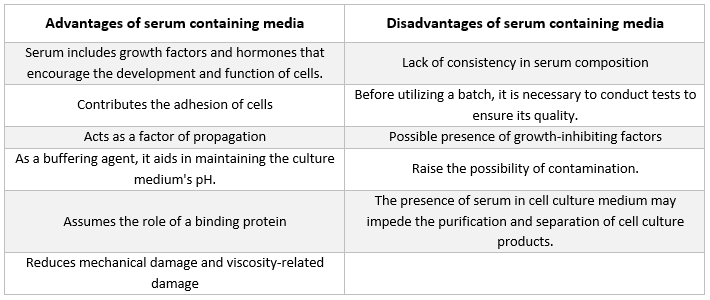
ซีรั่มที่มีสารอาหาร

ชนิดของสารเสริมที่พบได้บ่อยที่สุดในอาหารเลี้ยงเซลล์สัตว์ที่ใช้ในการเพาะเลี้ยงคือเซรั่มจากเลือดของลูกวัวในครรภ์ (fetal bovine serum) โดยจะถูกเติมลงในอาหารเลี้ยงเซลล์เพื่อเป็นสารเสริมที่มีต้นทุนต่ำ เพื่อให้ได้สภาวะที่เหมาะสมที่สุดสำหรับการเจริญเติบโตของเซลล์ นอกจากทำหน้าที่เป็นตัวขนส่งหรือตัวจับสารอาหารที่ไม่เสถียรหรือไม่ละลายน้ำ ฮอร์โมนและปัจจัยการเจริญเติบโต ตัวยับยั้งโปรตีเอส และสารอื่นๆ แล้ว ซีรั่มยังจับและทำให้โมเลกุลที่เป็นอันตรายเป็นกลางอีกด้วย

อาหารเลี้ยงเชื้อปราศจากซีรัม

การมีอยู่ของซีรัมในสื่อมีข้อเสียหลายประการและมีศักยภาพที่จะก่อให้เกิดข้อผิดพลาดสำคัญในการตีความในการวิจัยทางภูมิคุ้มกัน [2, 3] มีการสร้างสื่อปราศจากซีรัมหลากหลายรูปแบบขึ้นมาแล้ว [4, 5] สื่อเหล่านี้มักถูกพัฒนาขึ้นเป็นพิเศษเพื่อสนับสนุนการเพาะเลี้ยงของเซลล์ชนิดเดียว เช่น Knockout Serum Replacement และ Knockout DMEM จาก Thermo Fisher Scientific และ mTESR medium จาก Stem Cell Technologies [6] สำหรับเซลล์ต้นกำเนิด [7]

นอกจากนี้ สื่อเหล่านี้ยังประกอบด้วยปริมาณที่กำหนดไว้ของปัจจัยการเจริญเติบโตที่บริสุทธิ์, ไลโปโปรตีน, และโปรตีนอื่น ๆ ซึ่งโดยปกติแล้วจะได้รับจากซีรัม [8] สื่อเหล่านี้มักถูกเรียกว่า "สื่อเพาะเลี้ยงที่กำหนดไว้" เนื่องจากส่วนประกอบที่ประกอบขึ้นเป็นสื่อเหล่านี้เป็นที่เข้าใจกันดี

มีเดียที่กำหนดด้วยสารเคมี

สื่อเหล่านี้ประกอบด้วยส่วนประกอบอนินทรีย์และอินทรีย์ที่มีความบริสุทธิ์สูงมากซึ่งไม่ได้รับการปนเปื้อนจากสิ่งแปลกปลอมใด ๆ ทั้งสิ้น นอกจากนี้ยังอาจมีการเติมโปรตีนบริสุทธิ์ เช่น ปัจจัยการเจริญเติบโต ลงไปอีกด้วย

 การดัดแปลงพันธุกรรมของแบคทีเรียหรือยีสต์ ร่วมกับการเติมกรดไขมัน วิตามิน คอเลสเตอรอล และกรดอะมิโนเฉพาะบางชนิด ส่งผลให้เกิดการผลิตส่วนประกอบของสิ่งเหล่านี้ [9]

อาหารเลี้ยงเชื้อปราศจากโปรตีน

อาหารเลี้ยงเชื้อที่ไม่มีโปรตีนคืออาหารที่ไม่มีการเติมโปรตีนเลย และประกอบด้วยองค์ประกอบที่ไม่ใช่โปรตีนเท่านั้น เมื่อเปรียบเทียบกับอาหารที่มีเซรั่มเติมเข้าไป การใช้สื่อที่ไม่มีโปรตีนเติมจะส่งเสริมการเพิ่มจำนวนของเซลล์และการแสดงออกของโปรตีนได้ดีขึ้น และทำให้การแยกผลิตภัณฑ์ที่เกิดขึ้นในกระบวนการต่อไปง่ายขึ้น [10-12] โปรตีนไม่ได้รวมอยู่ในสูตรอาหารเช่น MEM และ RPMI-1640 อย่างไรก็ตาม อาจมีการให้สารอาหารเสริมโปรตีนหากจำเป็น

อาหารเลี้ยงเชื้อและส่วนประกอบพื้นฐาน

อาหารเลี้ยงเชื้อเชิงพาณิชย์สามารถซื้อได้ทั้งในรูปแบบผงหรือของเหลว และมักประกอบด้วยสารอาหารหลากหลายชนิด เช่น กรดอะมิโน กลูโคส เกลือแร่ วิตามิน และสารอาหารเสริมอื่น ๆ 

ความต้องการสำหรับส่วนประกอบเหล่านี้แตกต่างกันสำหรับแต่ละสายเซลล์ และความแตกต่างเหล่านี้เป็นสาเหตุให้เกิดจำนวนสูตรอาหารเลี้ยงเชื้อที่แตกต่างกันมากมาย แต่ละส่วนประกอบมีหน้าที่เฉพาะ ซึ่งจะอธิบายในย่อหน้าต่อไปนี้:

ระบบบัฟเฟอร์

เพื่อรักษาสภาพการเจริญเติบโตที่เหมาะสม pH ต้องได้รับการควบคุม ซึ่งมักทำโดยหนึ่งในสองระบบบัฟเฟอร์:

ระบบบัฟเฟอร์ธรรมชาติ

อัตราส่วนของ CO2/H2CO3 ในบรรยากาศเท่ากับอัตราส่วนในตัวกลาง ซึ่งสร้างกลไกการบัฟเฟอร์ตามธรรมชาติ เพื่อรักษาการบัฟเฟอร์ตามธรรมชาตินี้ไว้ สารละลายเพาะเลี้ยงต้องถูกเก็บไว้ในสภาพแวดล้อมที่มีอากาศประกอบด้วย CO2 5-10% ซึ่งมักทำได้โดยใช้ตู้เพาะเลี้ยงที่มี CO2 หนึ่งในสิ่งที่ดีที่สุดเกี่ยวกับการใช้บัฟเฟอร์ธรรมชาติคือราคาถูกและปลอดภัย

HEPES

การบัฟเฟอร์ทางเคมีโดยใช้ซวิตไทรออน HEPES มีความสามารถในการบัฟเฟอร์สูงกว่าในช่วง pH 7.2-7.4 และไม่จำเป็นต้องใช้สภาพแวดล้อมที่มีก๊าซควบคุม สำหรับเซลล์บางประเภท การใช้ HEPES ในปริมาณมากเกินไปอาจเป็นอันตรายได้ สื่อที่มี HEPES เช่นเดียวกันนั้นมีความไวต่อผลกระทบจากแสงฟลูออเรสเซนต์มากขึ้นอย่างมาก [13]

ฟีโนล เรด

สารบ่งชี้ค่า pH ฟีนอลเรดมักถูกใส่ในอาหารเลี้ยงเชื้อที่มีจำหน่ายในเชิงพาณิชย์ ช่วยให้สามารถตรวจสอบค่า pH ได้อย่างต่อเนื่อง เมื่อเซลล์ขยายตัว สารเมตาบอไลต์ที่ผลิตโดยเซลล์เหล่านี้จะทำให้ค่า pH เปลี่ยนไป และส่งผลให้สีของอาหารเลี้ยงเชื้อก็เปลี่ยนไปด้วย ฟีโนลเรดมีผลสองประการต่อสีของอาหารเลี้ยงเชื้อ โดยเปลี่ยนเป็นสีเหลืองเมื่อมีค่า pH เป็นกรด และเปลี่ยนเป็นสีม่วงเมื่อมีค่า pH เป็นด่าง ที่ค่า pH 7.4 ซึ่งเป็นค่าที่เหมาะสมสำหรับการเพาะเลี้ยงเซลล์ อาหารเลี้ยงเชื้อจะปรากฏเป็นสีแดงเรืองแสง

แต่ฟีโนลเรดมีข้อเสียบางประการ: ประการแรก ฟีโนลเรดสามารถจำลองการทำงานของฮอร์โมนสเตียรอยด์หลายชนิดได้ โดยเฉพาะเอสโตรเจน [14] ดังนั้น เมื่อศึกษาเซลล์ที่ไวต่อเอสโตรเจน เช่น เนื้อเยื่อเต้านม จึงแนะนำให้ใช้สารอาหารที่ไม่มีฟีโนลเรด สมดุลโซเดียม-โพแทสเซียมถูกรบกวนจากการมีฟีนอลเรดในสูตรปราศจากซีรัมหลายชนิด การเติมซีรัมหรือฮอร์โมนต่อมใต้สมองของวัวลงในมีเดียอาจช่วยต้านผลนี้ได้ [15] ประการที่สาม การตรวจพบในทดลองโฟลว์ไซโตเมตริกถูกขัดขวางจากการมีฟีนอลเรด

เกลืออนินทรีย์

สื่อที่มีเกลืออนินทรีย์ เช่น ไอออนของโซเดียม โพแทสเซียม และแคลเซียม ช่วยรักษาสมดุลออสโมติกและควบคุมศักย์เยื่อหุ้มเซลล์

กรดอะมิโน

เนื่องจากกรดอะมิโนเป็นองค์ประกอบพื้นฐานของโปรตีน จึงเป็นองค์ประกอบที่จำเป็นของทุกสื่อการเจริญเติบโตของเซลล์ที่เคยคิดค้นขึ้นมา เนื่องจากเซลล์ไม่สามารถผลิตกรดอะมิโนบางชนิดได้เอง จึงเป็นสิ่งสำคัญที่สื่อเพาะเลี้ยงจะต้องมีกรดอะมิโนที่จำเป็นรวมอยู่ด้วย พวกมันจำเป็นสำหรับการเพิ่มจำนวนของเซลล์ และความเข้มข้นที่พวกมันมีอยู่จะกำหนดความหนาแน่นสูงสุดของเซลล์ที่สามารถเกิดขึ้นได้ โดยเฉพาะอย่างยิ่ง แอล-กลูตามีน ซึ่งเป็นกรดอะมิโนที่จำเป็น มีความสำคัญอย่างยิ่ง

แอล-กลูตามีนทำหน้าที่เป็นแหล่งพลังงานรองสำหรับการเผาผลาญและช่วยให้นิโตรเจนในการผลิต NAD, NADPH และนิวคลีโอไทด์ เนื่องจากแอล-กลูตามีนเป็นกรดอะมิโนที่ไม่เสถียรซึ่งเมื่อเวลาผ่านไปจะเปลี่ยนเป็นรูปแบบที่เซลล์ไม่สามารถใช้ได้ จึงจำเป็นต้องให้แอล-กลูตามีนแก่สื่อ

นอกจากนี้ กรดอะมิโนที่ไม่จำเป็นอาจถูกเติมลงในอาหารเลี้ยงเชื้อเพื่อเติมเต็มกรดอะมิโนที่ถูกใช้ไปตลอดกระบวนการเจริญเติบโต การเจริญเติบโตของเซลล์จะเพิ่มขึ้นและความสามารถในการดำรงชีวิตของเซลล์จะเพิ่มขึ้นเมื่ออาหารเลี้ยงเชื้อถูกเติมด้วยกรดอะมิโนที่ไม่จำเป็น

คาร์โบไฮเดรต

คาร์โบไฮเดรตในรูปแบบของน้ำตาลเป็นแหล่งพลังงานหลัก สื่อหลายชนิดยังรวมถึงมอลโตสและฟรุกโตส นอกเหนือจากน้ำตาลที่พบได้ทั่วไปอย่างกลูโคสและกาแลคโตส

โปรตีนและเปปไทด์

อัลบูมิน, ทรานส์เฟอริน, และไฟโบรเนกติน เป็นโปรตีนและเปปไทด์ที่ใช้กันมากที่สุด พวกมันมีความสำคัญเป็นพิเศษในสื่อที่ไม่มีซีรัม อัลบูมิน, ทรานส์เฟอริน, อะโปรตีนิ, เฟทูอิน, และไฟโบรเนกติน เป็นโปรตีนบางชนิดที่อาจพบได้ในซีรัม ซึ่งเป็นแหล่งโปรตีนที่อุดมสมบูรณ์

อัลบูมินเป็นโปรตีนหลักที่พบในเลือด โดยมีหน้าที่จับและลำเลียงสารต่าง ๆ เช่น น้ำ เกลือแร่ กรดไขมันอิสระ ฮอร์โมน และวิตามิน ระหว่างอวัยวะและเซลล์ต่าง ๆ ความสามารถของอัลบูมินในการจับกับสารเคมีทำให้เป็นทางเลือกที่มีประสิทธิภาพในการกำจัดสารประกอบที่เป็นอันตรายออกจากสารละลายที่ใช้เพาะเลี้ยงเซลล์

อะโปรทินินเป็นสารป้องกันในระบบเพาะเลี้ยงเซลล์ เนื่องจากมีความเสถียรที่ค่า pH ที่เป็นกลางและกรด รวมถึงทนต่ออุณหภูมิสูงและการทำลายที่อาจเกิดจากเอนไซม์โปรตีโอไลติก นอกจากนี้ยังสามารถยับยั้งเอนไซม์เซรีนโปรตีเอสหลายชนิด รวมถึงทริปซิน

ฟีทูอินเป็นไกลโคโปรตีนที่อาจตรวจพบได้ในปริมาณที่สูงกว่าในซีรัมของสัตว์ในครรภ์และสัตว์แรกเกิดเมื่อเทียบกับซีรัมของสัตว์ที่โตเต็มวัย นอกจากนี้ ฟีทูอินยังทำหน้าที่เป็นสารยับยั้งเซรีนโปรตีเอส โปรตีนไฟโบรเนกตินเป็นองค์ประกอบที่สำคัญในกระบวนการยึดเกาะของเซลล์ ทรานส์เฟอร์รินเป็นโปรตีนที่ทำหน้าที่ขนส่งเหล็กและมีหน้าที่นำเหล็กไปยังเยื่อหุ้มเซลล์

กรดไขมันและไขมัน

พวกมันมีบทบาทสำคัญในอาหารเลี้ยงเชื้อที่ไม่มีซีรัมเมื่อไม่มีซีรัม

วิตามิน

วิตามินหลายชนิดมีความจำเป็นต่อการพัฒนาและการเพิ่มจำนวนของเซลล์ วิตามินไม่สามารถผลิตได้ในปริมาณที่เพียงพอโดยเซลล์ ดังนั้นจึงมีความสำคัญในวัฒนธรรมเนื้อเยื่อในฐานะอาหารเสริม

ในการเพาะเลี้ยงเซลล์ ซีรัมเป็นแหล่งวิตามินหลัก อย่างไรก็ตาม สารอาหารยังได้รับการเติมวิตามินต่างๆ เพื่อให้เหมาะสมกับชนิดของเซลล์ที่ต้องการ โดยทั่วไป วิตามินกลุ่มบีจะถูกใช้เพื่อกระตุ้นการเจริญเติบโต

ธาตุอาหารรอง

ธาตุเคมี เช่น ทองแดง สังกะสี ซีลีเนียม และสารตัวกลางของกรดไตรคาร์บอกซิลิก เป็นที่รู้จักกันในชื่อธาตุอาหารรอง ธาตุอาหารรองมักถูกเติมลงในสื่อที่ไม่รวมซีรัมเพื่อทดแทนธาตุที่มักพบในซีรัม ธาตุเหล่านี้เป็นองค์ประกอบทางเคมีที่สำคัญซึ่งจำเป็นต่อการพัฒนาของเซลล์ที่มีสุขภาพดี ปฏิกิริยาชีวเคมีหลายชนิดขึ้นอยู่กับสารอาหารรองบางชนิด เช่น การทำงานของเอนไซม์

อาหารเสริมขนาดกลาง

อาหารเลี้ยงเชื้อแบบสมบูรณ์ที่แนะนำสำหรับเซลล์ไลน์บางชนิดจำเป็นต้องมีส่วนประกอบเพิ่มเติมที่ไม่ได้อยู่ในอาหารพื้นฐานและซีรัม สารอาหารเสริมเหล่านี้ช่วยสนับสนุนการเจริญเติบโตของเซลล์และการทำงานเมตาบอลิซึมที่เหมาะสม

แม้ว่าฮอร์โมน ปัจจัยการเจริญเติบโต และโมเลกุลสัญญาณจะมีความจำเป็นต่อการเพิ่มจำนวนของเซลล์สายพันธุ์เฉพาะอย่างเหมาะสม แต่ควรปฏิบัติตามข้อควรระวังดังต่อไปนี้เสมอ: เนื่องจากการเติมสารเสริมอาจเปลี่ยนแปลงค่าออสโมลาริตีของอาหารเลี้ยงเซลล์ทั้งหมด ซึ่งอาจยับยั้งการพัฒนาของเซลล์ จึงควรตรวจสอบค่าออสโมลาริตีหลังจากเติมสารเสริมทุกครั้ง สำหรับเซลล์ไลน์ส่วนใหญ่ ค่าความเข้มข้นของออสโมลาลิตี้ที่เหมาะสมอยู่ระหว่าง 260 ถึง 320 mOSM/กก.

ยาปฏิชีวนะ

ยาปฏิชีวนะมักถูกนำมาใช้เพื่อยับยั้งการเจริญเติบโตของสารปนเปื้อนจากแบคทีเรียและเชื้อรา [16] แม้ว่ายาปฏิชีวนะจะไม่ใช่สิ่งจำเป็นสำหรับการเจริญเติบโตของเซลล์ก็ตาม เนื่องจากยาปฏิชีวนะอาจปกปิดการปนเปื้อนของไมโคพลาสมาและแบคทีเรียที่ต้านทานยาได้ การใช้ยาปฏิชีวนะเป็นประจำจึงไม่ได้รับการแนะนำสำหรับการเพาะเลี้ยงเซลล์ [17, 18]

นอกจากนี้ ยาปฏิชีวนะอาจรบกวนการเผาผลาญของเซลล์ที่มีความไวต่อสิ่งกระตุ้นสูง การผสมผสานระหว่างเพนิซิลลินและสเตรปโตมัยซินที่ผลิตโดย MilliporeSigma และ Life Technologies มักถูกนำมาใช้ Plasmocin ได้ถูกนำมาใช้ในการเพาะเลี้ยงเซลล์ไลน์ของเนื้องอกในสมองชนิด glioma ได้แก่ TS603, TS516 และ BT260 [19] และได้รับการพิสูจน์แล้วว่ามีประสิทธิภาพในการกำจัดเชื้อไมโคพลาสมาที่ปนเปื้อน (20)

ซีรั่ม

อัลบูมิน, ปัจจัยการเจริญเติบโต, และสารยับยั้งการเจริญเติบโต ล้วนมีอยู่ในซีรัม ซีรัมเป็นหนึ่งในส่วนประกอบที่สำคัญที่สุดของอาหารเลี้ยงเซลล์ เนื่องจากมันให้กรดอะมิโน, โปรตีน, วิตามิน (โดยเฉพาะวิตามินที่ละลายในไขมัน เช่น วิตามิน A, D, E, และ K), คาร์โบไฮเดรต, ไขมัน, ฮอร์โมน, ปัจจัยการเจริญเติบโต, แร่ธาตุ, และธาตุอาหารที่จำเป็นในปริมาณน้อย

ซีรั่มจากแหล่งรกและลูกวัวมักถูกนำมาใช้เพื่อส่งเสริมการพัฒนาของเซลล์เพาะเลี้ยง ซีรั่มจากรกเป็นแหล่งที่อุดมไปด้วยปัจจัยการเจริญเติบโตและเหมาะสมสำหรับการโคลนนิ่งเซลล์และการพัฒนาเซลล์ที่มีความไวสูง เนื่องจากความสามารถในการส่งเสริมการเจริญเติบโตที่ลดลง ซีรั่มจากลูกวัวจึงถูกนำมาใช้ในการทดลองเกี่ยวกับการยับยั้งการเจริญเติบโตแบบสัมผัส อาหารเลี้ยงเชื้อปกติมักประกอบด้วยซีรัม 2% ถึง 10% การเติมซีรัมลงในอาหารเพาะเลี้ยงมีวัตถุประสงค์ดังต่อไปนี้ [21]:

  • เซรั่มนี้ส่งมอบสารอาหารที่จำเป็นสำหรับเซลล์ (ทั้งในรูปแบบที่ละลายอยู่ในสารละลายและที่เกาะติดกับโปรตีน)

  • ปัจจัยการเจริญเติบโตและฮอร์โมนหลายชนิดที่เกี่ยวข้องกับการส่งเสริมการเจริญเติบโตและการทำงานของเซลล์เฉพาะทางถูกบรรจุอยู่ในซีรัม

  • มันมีโปรตีนที่จับกับสารต่าง ๆ มากมาย เช่น อัลบูมินและทรานส์เฟอร์ริน ซึ่งทำหน้าที่ขนส่งสารเคมีอื่น ๆ เข้าสู่เซลล์ ตัวอย่างเช่น อัลบูมินจะลำเลียงไขมัน วิตามิน ฮอร์โมน ฯลฯ เข้าสู่เซลล์

  • นอกจากนี้ยังให้โปรตีน เช่น ไฟโบรเนคติน ซึ่งช่วยเพิ่มการยึดเกาะของเซลล์กับพื้นผิว นอกจากนี้ยังผลิตองค์ประกอบที่ช่วยในการแพร่กระจายซึ่งช่วยในการขยายตัวของเซลล์ก่อนการแบ่งตัว

  • มันส่งมอบโปรตีเอสอินฮิบิเตอร์ที่ป้องกันการสลายโปรตีนในเซลล์

  • นอกจากนี้ยังมีแร่ธาตุเช่น Na+, K+, Zn2+ และ Fe2+

  • มันช่วยเพิ่มความหนืดของสื่อ จึงช่วยปกป้องเซลล์จากการบาดเจ็บทางกลระหว่างการเขย่าในวัฒนธรรมแบบแขวนลอย

  • มันยังเป็นกันชนด้วย

เอกสารอ้างอิง

[1] มอร์แกน เจ, มอร์ตัน เอช, พาร์คเกอร์ อาร์. โภชนาการของเซลล์สัตว์ในวัฒนธรรมเนื้อเยื่อ; การศึกษาเบื้องต้นเกี่ยวกับอาหารสังเคราะห์. Proc Soc Exp Biol Med. 1950;73:1-8

[2] Kerbel R, Blakeslee D. การดูดซับอย่างรวดเร็วของส่วนประกอบในซีรั่มลูกวัวโดยเซลล์สัตว์เลี้ยงลูกด้วยนมในวัฒนธรรม. แหล่งที่มาที่เป็นไปได้ของสิ่งประดิษฐ์ในการศึกษาแอนติซีรั่มต่อแอนติเจนเฉพาะเซลล์. ภูมิคุ้มกันวิทยา. 1976;31:881-91

[3] Sula K, Draber P, Nouza K. การเติมซีรัมลงในอาหารเลี้ยงเชื้อที่ใช้ในการเตรียมสารแขวนลอยของเซลล์เป็นแหล่งที่มาของสิ่งผิดปกติในปฏิกิริยาที่เซลล์เป็นสื่อกลางซึ่งศึกษาโดยใช้การทดสอบต่อมน้ำเหลืองบริเวณขาหนีบ J Immunogenet. 1980;7:483-9

[4] มาริอาเนอี, มาริอาเนอา, มอนาโกเอ็ม, ลาลีอี, วิตัลีเอ็ม, ฟาชินีอา. สื่อเลี้ยงเซลล์เชิงพาณิชย์ปราศจากซีรัม: การเจริญเติบโตของไฮบริโดมาและการผลิตแอนติบอดีโมโนโคลนอล. J Immunol Methods. 1991;145:175-83

[5] บาร์นส์ ดี, ซาโตะ จี. วิธีการเพาะเลี้ยงเซลล์ในอาหารเลี้ยงเชื้อปราศจากซีรัม. Anal Biochem. 1980;102:255-70

[6] Yu H, Lu S, Gasior K, Singh D, Vazquez Sanchez S, Tapia O, และคณะ. HSP70 ชำระ RNA-free TDP-43 เข้าไปในเปลือกทรงกลมของเหลวภายในนิวเคลียสที่ไม่เป็นเนื้อเดียวกัน. Science. 2021;371:

[7] Meharena H, Marco A, Dileep V, Lockshin E, Akatsu G, Mullahoo J, และคณะ. การชราภาพที่เกิดจากกลุ่มอาการดาวน์รบกวนโครงสร้างนิวเคลียร์ของเซลล์ต้นกำเนิดประสาท. เซลล์ สเต็มเซลล์. 2022;29:116-130.e7

[8] Iscove N, Melchers F. การแทนที่ซีรัมทั้งหมดด้วยอัลบูมิน, ทรานส์เฟอริน และลิพิดจากถั่วเหลืองในวัฒนธรรมของเซลล์บีลิมโฟไซต์ที่ตอบสนองต่อลิโพโพลีแซ็กคาไรด์. J Exp Med. 1978;147:923-33

[9] Stoll T, Muhlethaler K, von Stockar U, Marison I. การปรับปรุงอย่างเป็นระบบของอาหารเลี้ยงเชื้อที่กำหนดด้วยสารเคมีและปราศจากโปรตีนสำหรับการเจริญเติบโตของไฮบริโดมาและการผลิตแอนติบอดีชนิดโมโนโคลนอล. J Biotechnol. 1996;45:111-23

[10] ดาร์ฟเลอร์ เอฟ. สารอาหารปราศจากโปรตีนสำหรับการเจริญเติบโตของไฮบริโดมาและเซลล์อื่น ๆ ของระบบภูมิคุ้มกัน. In Vitro Cell Dev Biol. 1990;26:769-78

[11] บาร์นส์ ดี, ซาโตะ จี. การเพาะเลี้ยงเซลล์ปลอดซีรัม: แนวทางที่เป็นหนึ่งเดียว. เซลล์. 1980;22:649-55

[12] แฮมิลตัน ดับเบิลยู, แฮม อาร์. การเจริญเติบโตแบบโคลนของสายพันธุ์เซลล์แฮมสเตอร์จีนในอาหารเลี้ยงเซลล์ปราศจากโปรตีน. In Vitro. 1977;13:537-47

[13] Zigler J, Lepe Zuniga J, Vistica B, Gery I. การวิเคราะห์ผลของสารพิษต่อเซลล์ของอาหารเพาะเลี้ยงที่มี HEPES ซึ่งได้รับแสง. In Vitro Cell Dev Biol. 1985;21:282-7

[14] Berthois Y, Katzenellenbogen J, Katzenellenbogen B. ฟีนอลแดงในอาหารเลี้ยงเซลล์เนื้อเยื่อเป็นเอสโตรเจนอ่อน: ผลกระทบต่อการศึกษาเซลล์ที่ตอบสนองต่อเอสโตรเจนในวัฒนธรรม. Proc Natl Acad Sci U S A. 1986;83:2496-500

[15] คาร์เมียล เอส. การพัฒนาสื่อปลอดซีรัม. ใน: มาสเตอร์ เจอาร์ดับเบิลยู, บรรณาธิการ. การเพาะเลี้ยงเซลล์สัตว์, ฉบับที่ 3. ออกซฟอร์ด: สำนักพิมพ์มหาวิทยาลัยออกซฟอร์ด; 2000.

[16] Perlman D. การใช้ยาปฏิชีวนะในอาหารเลี้ยงเซลล์. Methods Enzymol. 1979;58:110-6

[17] McGarrity G. การแพร่กระจายและการควบคุมการติดเชื้อไมโคพลาสมาในวัฒนธรรมเซลล์ In Vitro. 1976;12:643-8

[18] Masters J, Stacey G. การเปลี่ยนอาหารเลี้ยงเซลล์และการเพาะเลี้ยงเซลล์สายพันธุ์ในหลอดทดลอง. Nat Protoc. 2007;2:2276-84

[19] จักรวรรตี เอ, เลาคก้า ที, มิลลิโคสกี เอ็ม, ริงเกล เอ, บุ๊คเกอร์ เอ็ม, โทลสตอร์คูคอฟ เอ็ม, และคณะ. เฮสโตน เดเมทิลเอส KDM6A ตรวจจับออกซิเจนโดยตรงเพื่อควบคุมโครมาตินและชะตากรรมของเซลล์. วิทยาศาสตร์. 2019;363:1217-1222

[20] โมลลา คาเซมีฮา วี, อาซารี เอส, อามันซาเดห์ เอ, โบนาคดาร์ เอส, โชจาอี มอกดาห์ม เอ็ม, Habibi Anbouhi M, et al. ประสิทธิภาพของ Plasmocin™ ต่อเซลล์สายพันธุ์ต่างๆ ของสัตว์เลี้ยงลูกด้วยนมที่ติดเชื้อโมลลิคูทเมื่อเปรียบเทียบกับยาปฏิชีวนะที่ใช้กันทั่วไปในการเพาะเลี้ยงเซลล์: ประสบการณ์ในท้องถิ่น. Cytotechnology. 2011;63:609-20

[21] Kragh Hansen U. แง่มุมทางโมเลกุลของการจับสารลิแกนด์กับอัลบูมินในซีรัม. Pharmacol Rev. 1981;33:17-53